

Scroll Top
19th Ave New York, NY 95822, USA

Health-Care-and-Mental-Health-Professionals

HEALTH CARE AND MENTAL HEALTH PROFESSIONALS

An Extreme Risk Protection Order (ERPO) protects patients and others. It's a life-saving tool that prevents gun violence.

A diverse group of male and female healthcare professionals, including doctors and nurses, stand together smiling against a plain white background.

What are Extreme Risk Protection Orders?

When an individual poses a threat to themselves or others and has access to a firearm, an Extreme Risk Protection Order, or ERPO, can help. It’s a safe, legal measure that can save lives. Commonly known as “red flag laws,” these orders are designed to prevent gun violence and suicides by temporarily restricting an individual's access to firearms, or restricting their ability to purchase new ones, during a time of crisis when they may pose a safety risk to themselves or others.

There are two types:

  • A Temporary Extreme Risk Protection Order (TERPO) can be filed if there is an immediate risk and will last for up to 14 days.
  • An Extreme Risk Protection Order (ERPO) is issued after a full hearing and can extend firearm restrictions for up to 364 days.

Preview image of E-Learning course page titled “Module 1: Extreme Risk Protection Orders 101,” showing an overview section beside a photo of a healthcare provider talking with an older man.

FREE E-LEARNING COURSE FOR HEALTH CARE AND MENTAL HEALTH PROFESSIONALS

The course is designed to help health care and mental health professionals feel equipped and confident when considering whether to file an Extreme Risk Protection Order as a tool to prevent gun violence. Course modules cover topics like how they work, how to identify potential risks in patients, how to navigate the filing process, and what to expect after filing. Upon course completion, mental health and medical professionals earn one hour of CME (Continuing Medical Education)/CE (Continuing Education) credit.

A dark blue speech bubble with a white lowercase letter i in the center, set against a light blue background, representing information or an information icon.

YOU SHOULD KNOW:

ERPOs are preventative; they are not punitive measures but are designed to reduce harm during a period of crisis. ERPOs do not appear on a respondent's criminal record. They are civil orders intended to prevent harm, not punish individuals.

FACTS

Extreme Risk Protection Orders have been available in multiple states for many years and have been shown to reduce gun violence.

WHO CAN FILE?

Health care and mental health providers are often in the best position to recognize the warning signs that an individual may be experiencing a crisis and poses a risk of harm to self or others.
Any licensed health care professional or mental health professional who, through a direct professional relationship, provided care to a patient within the last six months can petition for an Extreme Risk Protection Order if they believe and have evidence that a patient with access to firearms poses a significant risk to themselves or someone else.

Doctors
Nurses
Social Workers
Therapists
Psychologists

WHEN TO CONSIDER FILING AN ERPO?

Extreme Risk Protection Orders are one of many tools that may be used to help prevent potential gun violence in emergency situations.

There are a variety of other violence prevention tools that can also be considered. Other options to consider are:

A graphic of a toolbox holding a hammer, wrench, screwdriver, and pliers, with a blue tag labeled ERPO attached to the toolbox.

WHAT IS THE PROCESS FOR FILING?

Filing an Extreme Risk Protection Order is a straightforward process. This video provides clear steps to guide you through it.

Extreme Risk Protection Orders are used when a gun owner poses a significant risk of causing personal injury to themself or others by having access to a firearm. Maybe they have made credible threats to their own safety or to the safety of family members, coworkers, schoolmates, or others. In these moments, family members and certain professionals now have another way to help prevent violence and save lives.


FIVE STEPS TO PETITIONING FOR AN EXTREME RISK PROTECTION ORDER

1
GATHER INFORMATION – Document specific statements, behaviors, known access to firearms, or incidents that suggest significant risk. If possible, gather statements from your colleagues who also observed concerning behavior. Your employer may already have established internal protocols when someone is at risk of harming themselves or others. In some cases, your organization’s administration may serve as a co-petitioner and take lead on filing the paperwork.
2
COMPLETE THE PAPERWORK – Fill out the Temporary ERPO Petition (JDF 573) and the ERPO Information Sheet (JDF 577).The forms are available at any courthouse in Colorado or online at coloradojudicial.gov. You are legally allowed to disclose Protected Health Information, including health records typically covered by HIPAA, when filing for an ERPO in good faith.
3
FILE AT THE COURTHOUSE – Submit the petition paperwork and any supporting documentation in person at the courthouse in the county where the respondent resides. If you are unsure which court to contact, you can find it using the courts locator tool at coloradojudicial.gov.
4
ATTEND THE FIRST HEARING (Temporary Extreme Risk Protection Order or TERPO) – During this hearing, the judge reviews the evidence to determine if a TERPO should be issued. You will present your concerns and supporting documents. This hearing usually happens within 24 hours. The respondent will not be present at this hearing. If the TERPOs is granted, law enforcement will serve the order on the respondent and confiscate firearms as where appropriate. They will also notify the relevant federal and state agencies to prevent further firearm purchases.
5
ATTEND THE FINAL HEARING (Extreme Risk Protection Order or ERPO) – If the initial 14-day TERPO is granted, a 364-day ERPO hearing will be scheduled within 14 days to assess if the ERPO should be granted. Each side will have an opportunity to present their evidence and call witnesses.

TOOLKIT

Explore ready-to-use resources to help providers learn about ERPOs and communicate effectively about firearm safety and secure storage.

Resources that explain what Extreme Risk Protection Orders are, who can file them, when they may be appropriate, and how they help prevent gun violence and suicide by temporarily restricting firearm access during times of crisis.

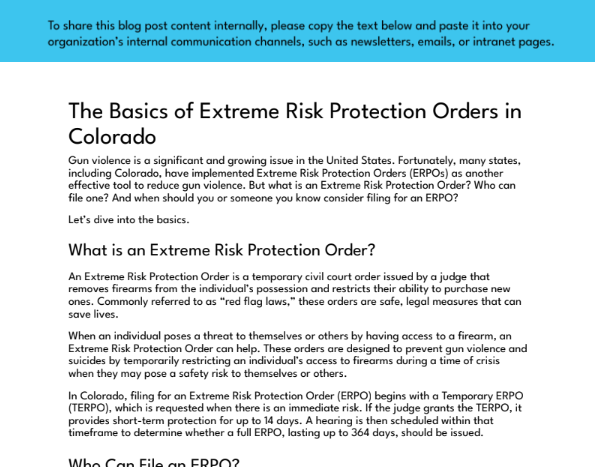
Preview image of a blog post titled “The Basics of Extreme Risk Protection Orders in Colorado,” showing introductory sections that explain what an ERPO is, how it works, and when someone might consider filing one.
BLOG The Basics of Extreme Risk Protection Orders in Colorado
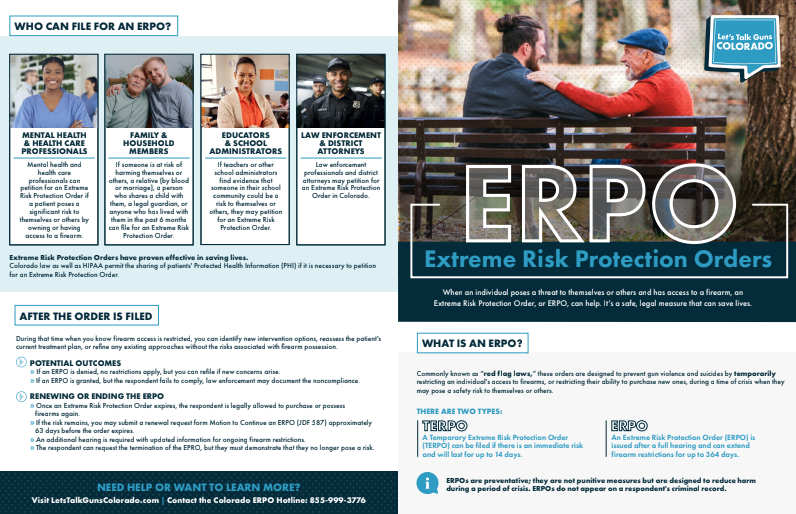
This shareable blog post provides a step-by-step overview of ERPOs, including what they are, who can file, when they are appropriate, and how to begin the process.

Preview image of a brochure about Extreme Risk Protection Orders (ERPOs), showing sections on who can file for an ERPO, what an ERPO is, what happens after an order is filed, and a large cover panel with two people talking on a park bench.
BROCHURE Extreme Risk Protection Orders
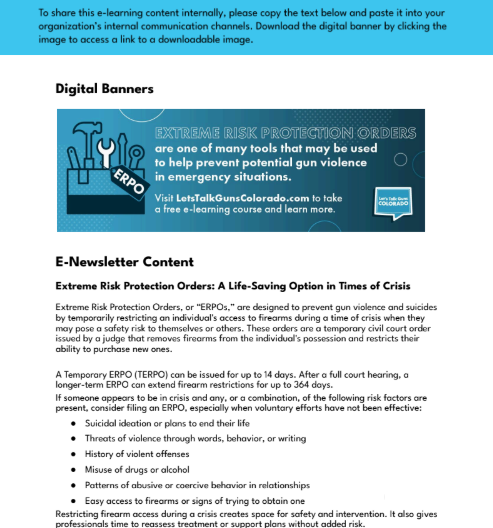
Designed for easy printing on standard copy paper or as a bifold brochure, this resource can be shared with staff, patients, or community members.

Preview image of E-Newsletter titled “Extreme Risk Protection Orders,” featuring icons of tools and a message about preventing gun violence in emergencies.
E-NEWSLETTER Extreme Risk Protection Orders: A Life-Saving Option in Times of Crisis
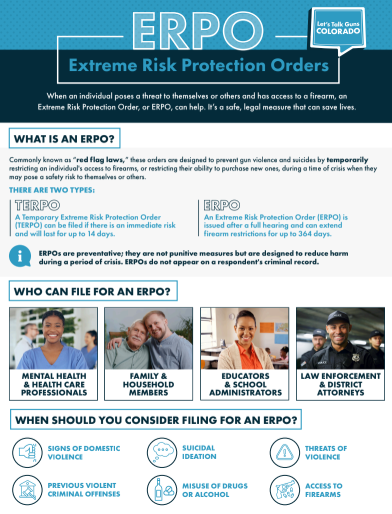
Content designed for newsletters with an accompanying banner for sharing among providers.

Preview image of an informational poster titled “ERPO: Extreme Risk Protection Orders,” explaining what an ERPO is, the difference between TERPO and ERPO, who can file for one, and signs that may indicate when an ERPO should be considered, accompanied by photos representing health professionals, families, educators, and law enforcement.
ONE-PAGER Extreme Risk Protection Orders
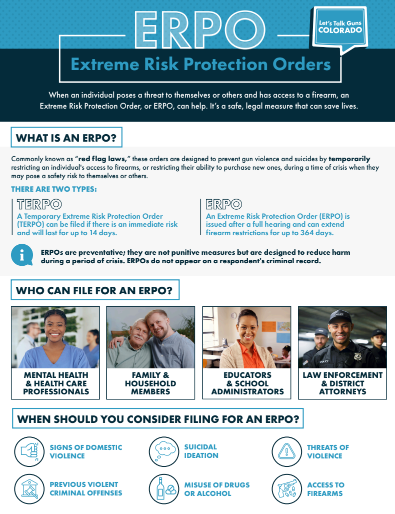
A quick-reference guide, available digitally or for print.

Preview image of an informational poster titled “ERPO: Extreme Risk Protection Orders,” explaining what an ERPO is, the two types (TERPO and ERPO), who can file for one, and warning signs that may indicate when filing should be considered, with photos representing different groups such as health professionals, families, educators, and law enforcement.
POSTER Extreme Risk Protection Orders

Designed for printing or digital sharing.

Resources to help providers lead respectful, patient-centered conversations about firearm safety and storage.

Preview image of a document titled “Talking About Gun Storage: A Guide for Health and Mental Health Professionals,” showing paragraphs about the importance of discussing firearm access, why these conversations matter, and guidance on how clinicians can begin the conversation.
BLOG Talking About Gun Storage: A Guide for Health Care and Mental Health Professionals.

Shareable blog content to support respectful, informed conversations about firearm safety with patients.

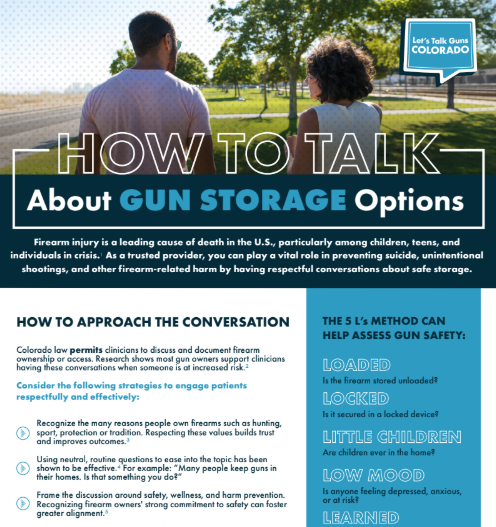
Preview image of a flyer titled “How to Talk About Gun Storage Options,” showing two people talking outdoors and outlining guidance for clinicians on discussing firearm safety, including conversation strategies and the “5 Ls” safety checklist.
ONE-PAGER How to Talk About Gun Storage Options

A printable or digital guide with respectful conversation tips and a visual overview of secure firearm storage to support patient safety.

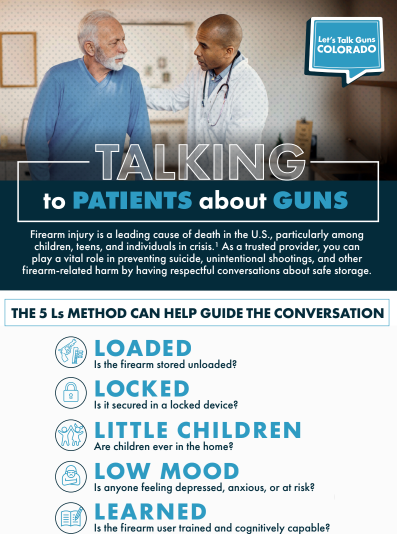
Preview flyer image showing a doctor speaking with an older man, titled “Talking to Patients about Guns.” It explains the importance of discussing firearm safety and presents the “5 Ls” conversation guide: Loaded, Locked, Little Children, Low Mood, and Learned.
POSTER Talking to Patients About Guns

Available to print or share digitally, this poster introduces the “5 Ls” as a tool for assessing firearm safety with patients.

These step-by-step videos walk providers through the ERPO filing process, and how to complete the Temporary ERPO (TERPO) forms.

VIDEOS What is the Process for Filing an ERPO?

Instructional videos that explain how to file an ERPO, from gathering documentation to attending court hearings.

Step 1 - Gather Initial Documentation and Decide Next Steps
Step 2 - Fill Out the Forms
Step 3 - File the Petition at the Courthouse
Step 4 - Attend the TERPO Hearing
Step 5 - Attend the ERPO Hearing
VIDEOS Guide to Completing the TERPO Forms

Instructional videos that walk through each section of the Temporary ERPO (TERPO) forms.

Part 1 - Guide to Completing the TERPO Petition Forms
Part 2 - Guide to Completing the TERPO Petition Forms - Caption Section
Part 3 - Guide to Completing the TERPO Petition Forms - Grounds for Issuing a TERPO
Part 4 - Guide to Completing the TERPO Petition Forms - Attachments and Affidavit

Downloadable social media posts and templates with accompanying captions that can be shared on internal organizational channels or among provider’s professional groups.

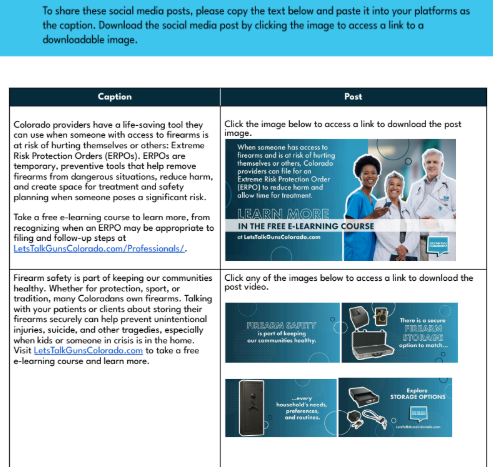
Preview image showing a two-column table titled “Caption” and “Post.” The left column contains short descriptions about ERPOs and firearm safety, and the right column shows preview thumbnails of the corresponding social media posts promoting an ERPO e-learning course and safe firearm storage options.
SOCIAL MEDIA Posts for Organizations
Social media posts and templates tailored for health care and mental health organizations to share information about Extreme Risk Protection Orders and secure firearm storage.

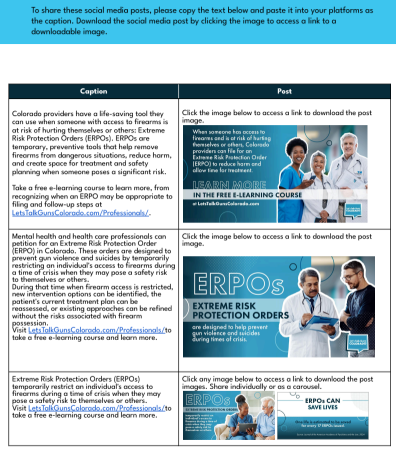
Preview image of a two-column table labeled “Caption” and “Post,” showing three caption blocks about Extreme Risk Protection Orders and three corresponding preview thumbnails of social media posts promoting ERPO information and e-learning resources.
SOCIAL MEDIA Posts for Health Care and Mental Health Professionals

Social media posts and templates tailored for health care and mental health professionals to share information about Extreme Risk Protection Orders and secure firearm storage.

Is it an emergency?

Dial 911 for immediate assistance.

A blue triangle with an exclamation mark inside is in front of a semicircular gauge or speedometer, also in blue, suggesting a warning or alert related to performance or levels.
This site is registered on wpml.org as a development site. Switch to a production site key to remove this banner.